The Compositions of Many Early Christian Reliefs Derive From Which Earlier Styles of Art?
The scriptures have for many centuries been a source of inspiration for Christian painters and sculptors. They have influenced great artists in many eras, leaving behind masterful examples of Medieval Christian art and religious Renaissance art for us to explore and enjoy. Allow u.s. take a deeper expect at the history of Christian artwork, Christian sculpture, and famous biblical paintings.
Table of Contents
- 1 A Brief History of Early Christian Art
- 1.i Symbolism in Early Christian Art
- one.2 Early Christian Fine art Before 313 CE
- 1.three Early Christian Art Subsequently 313 CE
- two Religious Renaissance Art
- ii.1 Madonna and Child (c. 1300) by Duccio di Buoninsegna
- two.2 The Last Supper (c. 1495) by Leonardo da Vinci
- 2.3 The Creation of Adam (1512) by Michelangelo
- 2.iv The Belfry of Babel (1563) by Pieter Bruegel the Elder
- 3 Notable Early Christian Artworks
- 3.1 Sarcophagus of Junius Bassus
- 3.2 Basilica of Sant'Apollinare Nuovo
- 3.3 Moses Striking the Stone (1624) – Joachim Anthonisz Wtewael
- iii.4 Adoration of the Magi (1481) by Leonardo da Vinci
- 3.five Transfiguration (1516 – 1520) by Raphael
- 4 Oft Asked Questions
- four.1 Why Is It So Hard to Find Early on Examples of Christian Art?
- 4.2 What Subject field Thing Did Early Christian Artists Paint?
A Brief History of Early Christian Art
Tracing the early days of Christian artwork can be a difficult task to undertake. Earlier 100 CE, Christians were a persecuted minority, so the chances of them being allowed to create fine art at this time were rather slim. At that time, Christianity was a small fringe organized religion with very few followers and footling to no public recognition or back up, so Christian painters would not accept had the luxury of financial back up from patrons.
Information technology was also forbidden to create idols, so this too could have influenced the lack of art from earlier 100 CE. Historians and scholars take divided Early on Christian art into 2 singled-out periods: Earlier 313 CE and afterward 313 CE, as this was the year of the Edict of Malan.
Let united states now explore the various periods of early Christian artwork and Christian sculptures.
Symbolism in Early Christian Art
Under the Roman Empire in the earliest days of Christianity, Christian artwork was intentionally cryptic so that the Christian undertones could not be noticed by the eyes of the Roman oppressors. They incorporated Christian themes subtly into imagery that was accepted within the predominantly Pagan civilisation. The first examples of Christian art still surviving today were establish in the catacombs of Rome, on surfaces in Christian burying tombs, dated to be from somewhere between the 2d to 4th centuries.
To hide the pregnant of these early Christian artworks, artists represented the figure of Jesus symbolically with pictogram symbols such as the peacock, lamb, fish, or anchor.
The symbol of the cantankerous was not used to correspond Jesus until many centuries later on, equally in the early days of Christianity, crucifixion was a common form of punishment for various offenses and therefore would not have been exclusively linked with Christianity, just rather with incivility. Another symbol ofttimes used to stand for Christ was the symbol of unity and peace, the dove.
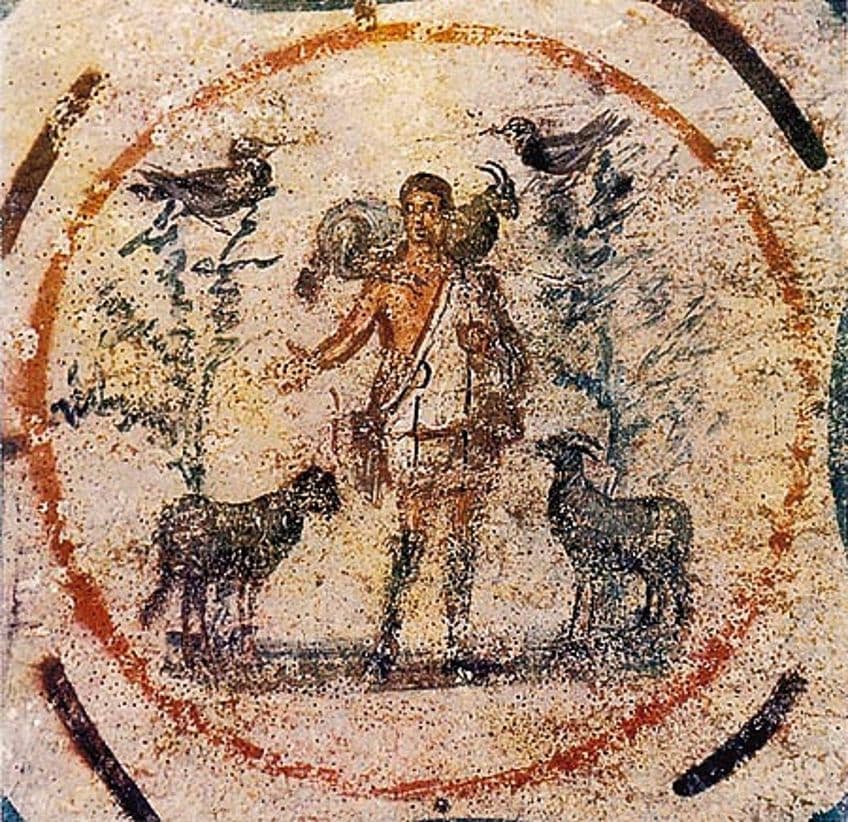 Centre of the ceiling of the "Velatio" cubicle: the Proficient Shepherd (too sheep and doves with olive branches in trees). Location: Catacomb of Priscilla, Italian republic, Rome, second half of the 3rd century;Unknown Unknown, Public domain, via Wikimedia Eatables
Early on Christian Art Before 313 CE
Besides the early on Roman occupation discrimination against Christianity and Christian art, there are several other possible factors that could take resulted in a lack of art representing Christian figures. The people of that fourth dimension were influenced past several dissimilar theologies and philosophies; some believed that God could be experienced directly, others thought he couldn't, and others thought that if he could, then he should not exist physically depicted.
Mod historians have suggested that it was perchance the prominent belief at the time that it was simply not possible to perceive the divine, let solitary recreate it.
Historians as well suggest that perhaps the main reason Christian art does not exist in the earliest days of the religion is that the majority of folk were poor and did not own any property. Once the economical situation improved for them, they were able to beget to indulge in hobbies such as Christian paintings, Christian sculptures, and Christian compages.
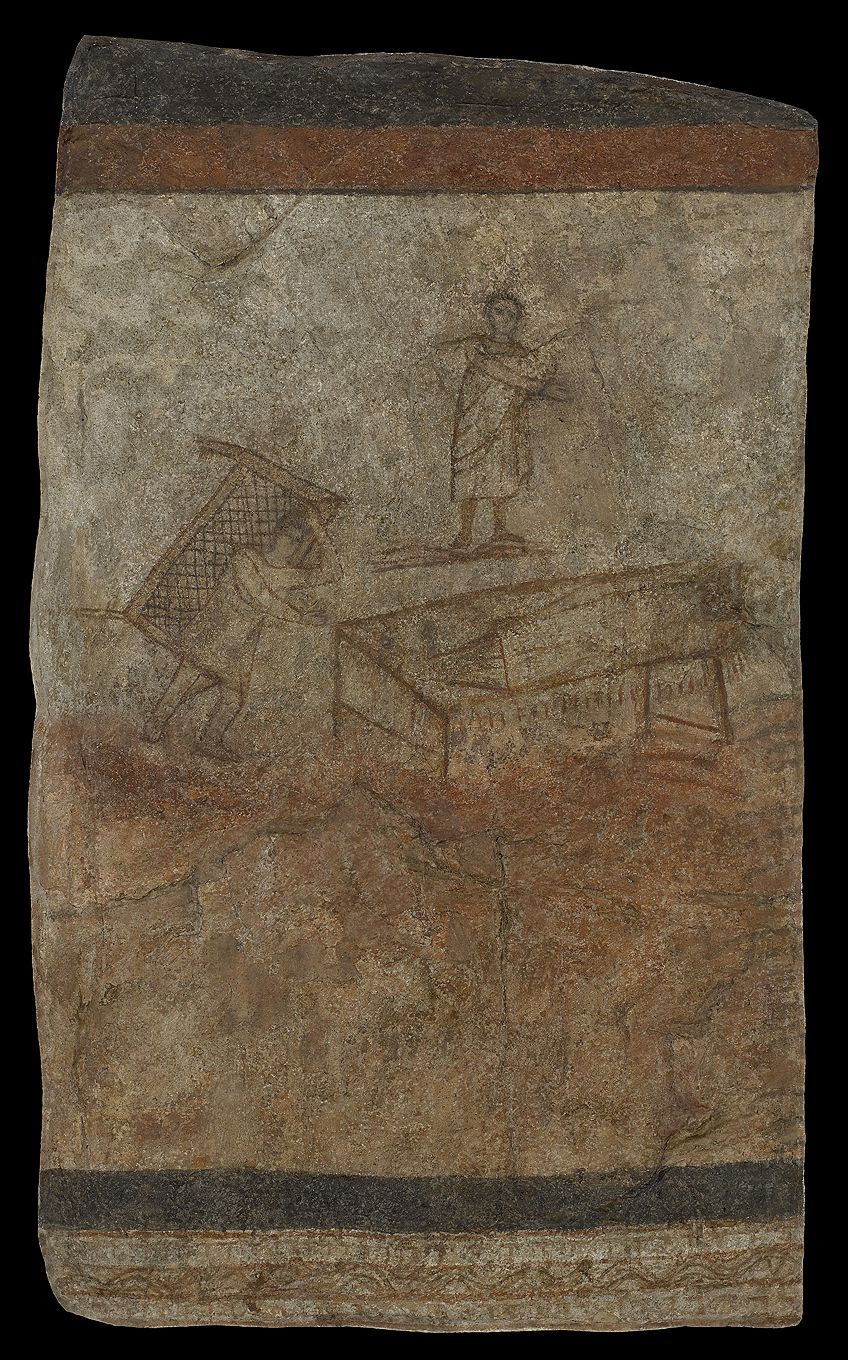 Photo of a painting of Jesus healing the paralytic from the wall of the baptistery in the Dura-Europa church, circa 232 A.D. It is one of the earliest visual depictions of Jesus. It was excavated by the Yale-French Excavations between 1928-37 in present-day Syrian arab republic and now resides in the Yale Academy Art Gallery in New Oasis, CT;Yale University Fine art Gallery, Public domain, via Wikimedia Commons
The Dura-Europos church is considered to be the oldest church nevertheless in good condition, and information technology has been dated between the periods 230 CE to 256 CE. This edifice was originally a house that was later converted into a church, and in it, there are biblical paintings on the walls, including images of Jesus every bit both the shepherd and the Christ. The catacombs of Rome were created a few decades before the Dura-Europos church, however, these earliest examples of Christian art only depicted praying as opposed to the actual epitome of Jesus seen later in the Church building house.
Stylistically, these early Christian paintings that adorned the walls of the catacombs were very like to other catacombs of many other religious groups, including the Roman mystery religions, paganism, or those that belonged to members of the Jewish organized religion. Compared to the fine art of the rich, these paintings were relatively depression in quality, but depicted a charming expressiveness of the figures.
Early on Christian art from this period often created "abbreviated" scenes, where well-known religious incidents were represented by one to four figures.
This fitted in with the Roman mode of compartmentalizing the art in the room with various geometric layouts. A pop subject at this time was the representation of biblical figures existence rescued from mortal danger in some way, such as biblical paintings depicting the Cede of Isaac, Noah kneeling in prayer in the ark, the resurrection of Jesus, and Jonah and the Whale.
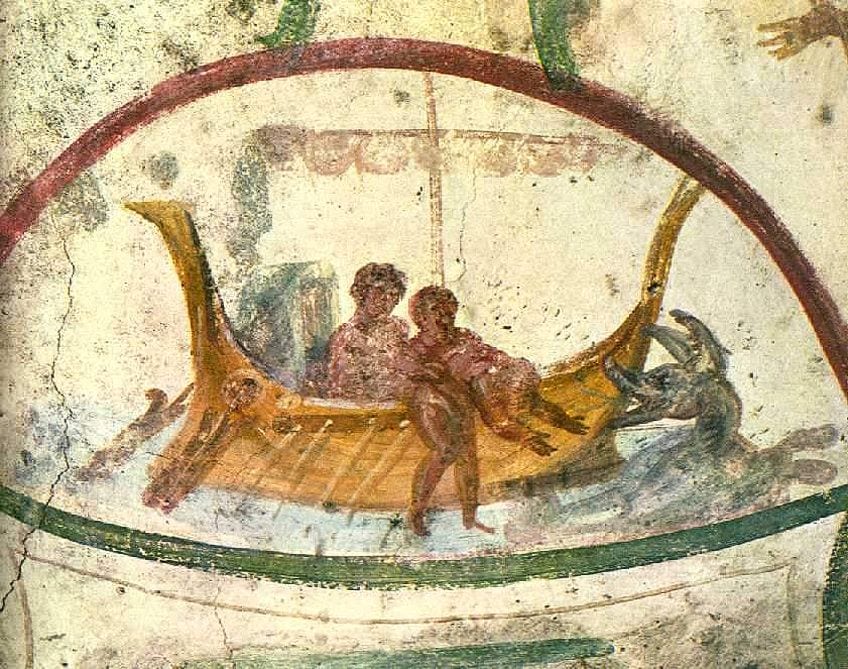 Picture of the prophet Jonah existence thrown into the Sea. From the catacomb of Saint Peter and Saint Marcellino, Rome, Italy, c. fourth century;Public Domain, Link
Christian sculptures from this period are very rare and mostly small in stature. Common motifs such as the Good Shepherd were prevalent as it was a symbolic figure found in many religions and therefore not strictly associated with Christian artwork. There were, however, about 270 small-scale figurines unearthed in modern Turkey, and some of these represent patently Christian iconography such as Jonah and the Whale.
Past the stop of the pre-Constantinian period, the portrayal of Jesus in Christian art had go accepted and fully developed.
Typical scenes from this period depict various stories from the New Attestation, every bit well every bit depictions of the passion of Christ. Many variations of his paradigm were depicted at this time, from a beardless and short-haired stocky fellow to the long-haired, thin-faced figure that has since become the nearly commonly adopted portrayal of Jesus.
Early on Christian Art Afterwards 313 CE
Emperor Constantine defeated Mexnethius in 312 CE, subsequently which he became the main patron of Christianity, transforming the religious landscape and the associated buildings dramatically. After he granted religious tolerance to Romans in 313 CE with the Edict of Milan, Rome changed towards an increasingly Christian territory.
It was the responsibility of the reigning emperor to create places of worship for his subjects, and these temples reflected the provincial religious faith at the time of his reign. It was no different for Constantine and Christianity. The small and discreet buildings usually used for religious worship before long proved to be too small afterward Christianity experienced an explosion in growth.
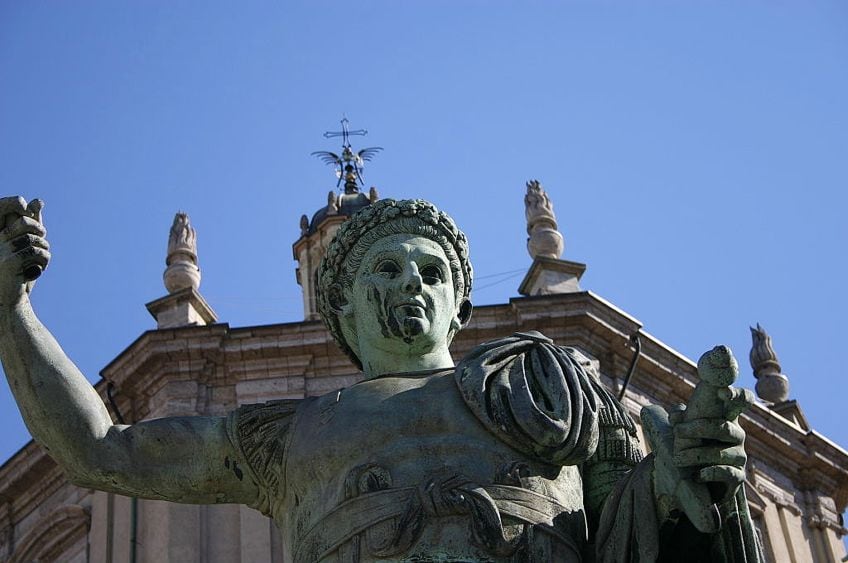 A close-upward of the monument of Roman emperor Constantine I, in front end of San Lorenzo Maggiore basilica. The statue was built by means of the "Edict of Milan" (Milan was then the capital of the Roman empire) in 313, which was a letter proclaiming religious toleration in the Roman Empire;Thou.dallorto, Attribution, via Wikimedia Eatables
Many pagan temples were still used by their original followers, and in some places like Rome, Christians refused to nourish worship there until they were converted to churches in the 6th and 7th centuries. Many temples were unsuitable for transition to Christian accommodation as pagans mostly used their windowless temples for the storage of religious objects and worshipped outside.
Thus, Constantine set about constructing churches such as the Church building of St. Peter in Rome, the Church of the Holy Sepulchre in Jerusalem, every bit well as many churches in the newly named capital city of Constantinople.
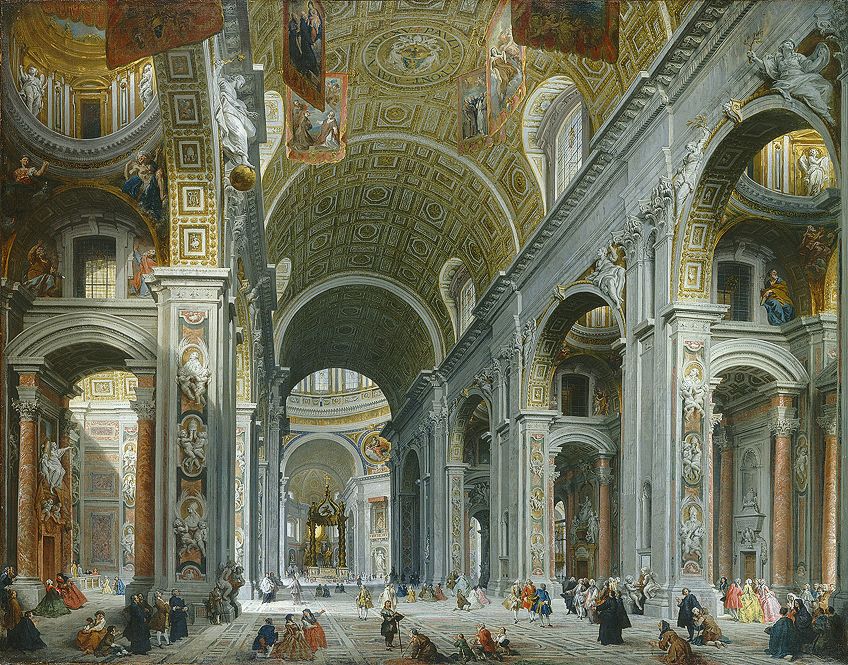 Interior of Saint Peter's, Rome(c. 1754) by Giovanni Paolo Panini;National Gallery of Fine art, CC0, via Wikimedia Commons
A major claiming that faced the architects was deciding on a new layout and form for religious worship, equally the previous designs were created for a dissimilar functionality than the Christian method of indoor communion. These new churches needed to exist large in order to house the e'er-growing Christian fellowship and to make a visible distinction between the faithless and the true-blue.
Based on these factors, it was decided to incorporate the architectural form of the basilica and adorn it appropriately with rich religious symbolism and artwork.
Basilicas were not new and had been congenital for centuries previously for use as extensions to palaces, public meeting halls, or courts of law. These courts ordinarily had a estimate presiding from a chair situated at the end of the hall in a semi-circular dome overlooking the hall. This imposing aesthetic carried over from court of law to place of worship, to the priest standing at his altar.
Religious Renaissance Art
During the 13th and 14th centuries, churches became massive patrons of Christian art and commissioned and bought big quantities of piece of work from Christian painters. Many members of the public were unable to write at this time, so fine art was used to aid them envision the scriptures, creating a sense of respect and awe amongst the customs. Churches hoped to utilize the fine art to create a deeper connection with their followers, hoping that the scenes of salvation and damnation would inspire or terrify them into existence more devoted.
Christian artists from the Early on Renaissance started calculation a touch of realism to their fine art, making the figures await more true to life and the settings more natural and realistic.
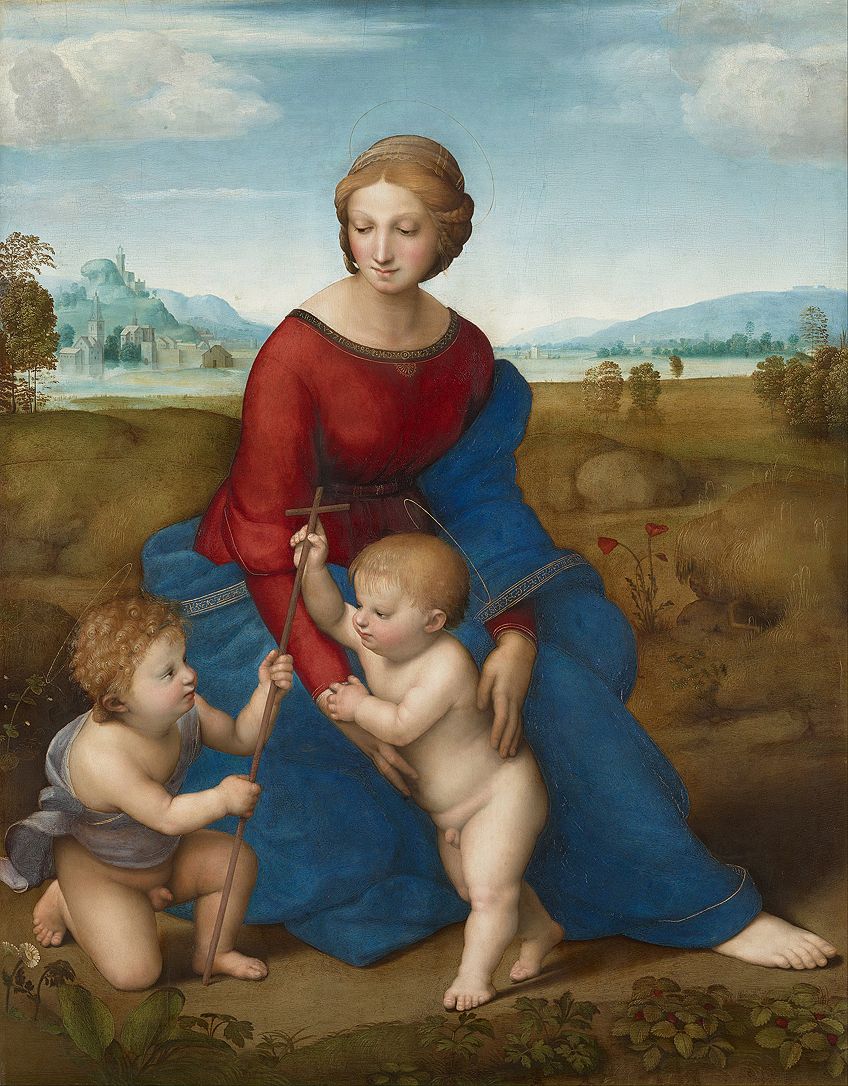 The Madonna of the Meadow (c. 1506) by Raphael;Raphael, Public domain, via Wikimedia Eatables
Past doing and so, they hoped to draw the viewer into the artwork and to sympathize more with the subjects and subject area matter past recognizing themselves in the faces and settings of the paintings. Throughout this catamenia, artists continued to refine their processes, becoming ever more influential on the masses and simultaneously influenced past the masses.
During this period, church elders were continuously stressing the humanity of Jesus and how the congregation should be leading their lives using his as an example. Therefore, the artwork of this time depicts a Jesus that portrays man frailties and suffering, as well as divinity and themes connected to images of his birth and decease. Both of these periods of Christ's life convey aspects of Christian belief that are a fundamental part of the doctrine, being the concepts of incarnation and resurrection.
Permit u.s. now look at a few examples of religious Renaissance art.
Madonna and Child (c. 1300) by Duccio di Buoninsegna
Duccio di Buoninsegna was an extremely influential Renaissance creative person of the early 14th century, and his version of the Madonna and child is idea to have been painted sometime around the year 1300. Compared to larger versions of the Madonna and child plant in churches and altars, this painting is comparatively small and was well-nigh likely created to be a personal paradigm for devotional use.
The painting's use for devotional purposes tin can exist hinted at by the burnt edges, most likely obtained from the use of candles at a pocket-size altar at its base of operations.
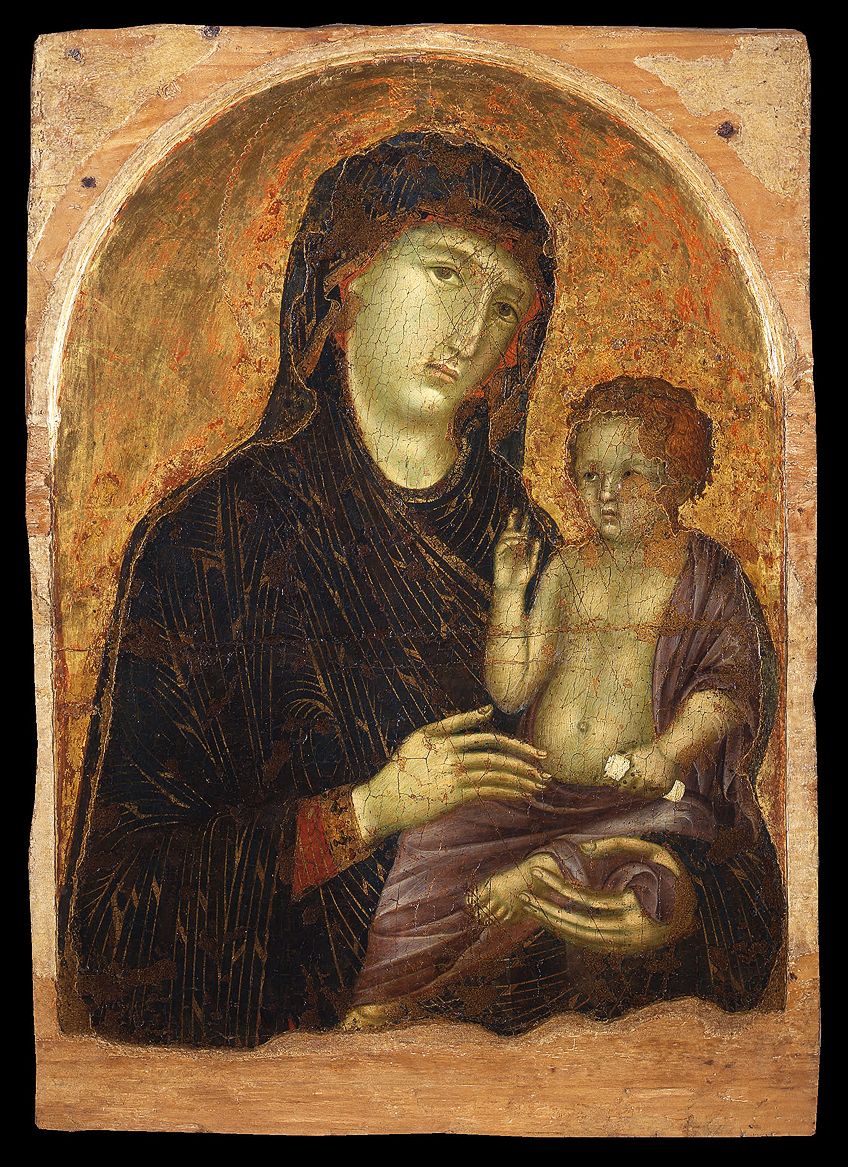 Madonna with Kid(between 1295 and 1305) by Duccio di Buoninsegna;Duccio di Buoninsegna, Public domain, via Wikimedia Commons
Despite the simplistic nature of the composition, this artwork marks a deviation from the Byzantine era'southward apply of less detailed iconic images, and the endeavor to move closer to portraying images likely to create an emotional connection between the viewer and the art piece.
These aspects of humanism can be seen in the creative person'due south use of emotive human gestures between the mother and the child sitting on her lap, every bit well every bit the detailed garments.
The Final Supper (c. 1495) by Leonardo da Vinci
Possibly one of the world's almost hands recognized paintings, Leonard da Vinci painted The Last Supper in the late 15th century. Housed in the Covenant of Santa Maria Delle Grazie in Milan, da Vinci started work on the painting effectually 1495 as part of a commissioned job to renovate the church building by his patron the Duke of Milan, Ludovico Sforza. Every bit the name suggests, the painting depicts the scene of Christ's last dinner with his apostles.
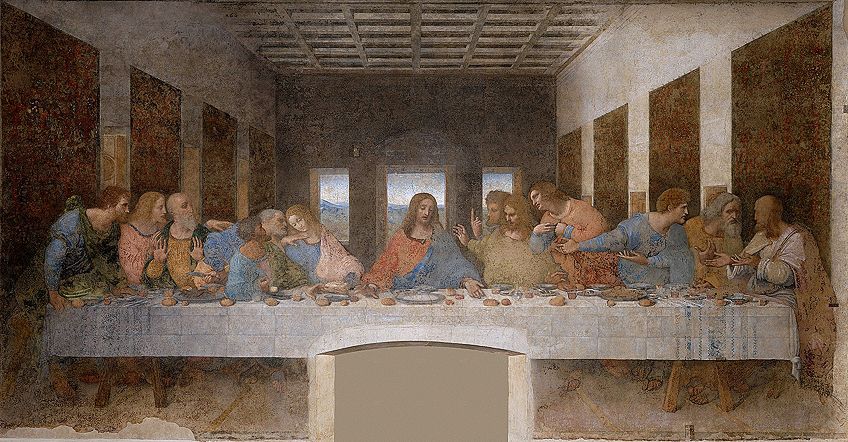 The Last Supper (1495-1498) by Leonardo da Vinci;Leonardo da Vinci, Public domain, via Wikimedia Eatables
Da Vinci has tried to capture the moment of consternation amidst his followers as he announces that i of the apostles would eventually beguile him. Each campaigner is depicted with a different reaction to his revelation, all displaying varying degrees of shock, anger, and disbelief. As was common with other paintings of the final supper from that era, da Vinci has positioned all the apostles at one side of the table so that none of them take their backs facing the viewer. Most other versions of this scene take Judas placed on the other end of the table away from all the apostles, but in his rendition, Leonardo placed Judas in the shadows.
Despite many attempts at restoration throughout the years, very little of the original painting still exists.
When Sforza renovated the church, his builders used moisture-retaining rubble to fill the walls, which resulted in the paint existence unable to get a decent grip on the walls from the showtime. In fact, the painting already began to show signs of deterioration soon after it was finished. Two copies of The Last Supper have been establish that were made past da Vinci's assistants before the final one was painted. Ane is now housed at the Royal Academy of Arts and the other is housed at the Church of St. Ambrogio in Switzerland.
The Creation of Adam (1512) past Michelangelo
Michelangelo painted this famous fresco from 1508 until 1512, and it forms part of the ceiling of the Sistine Chapel. Considered one of the most famous biblical paintings in the world, it depicts the moment God gave life to Adam.
Michelangelo was originally commissioned to paint the twelve apostles on the sides that support the ceiling, but he managed to convince Pope Julius to give him costless creative reign, suggesting a far more complex scheme than initially devised.
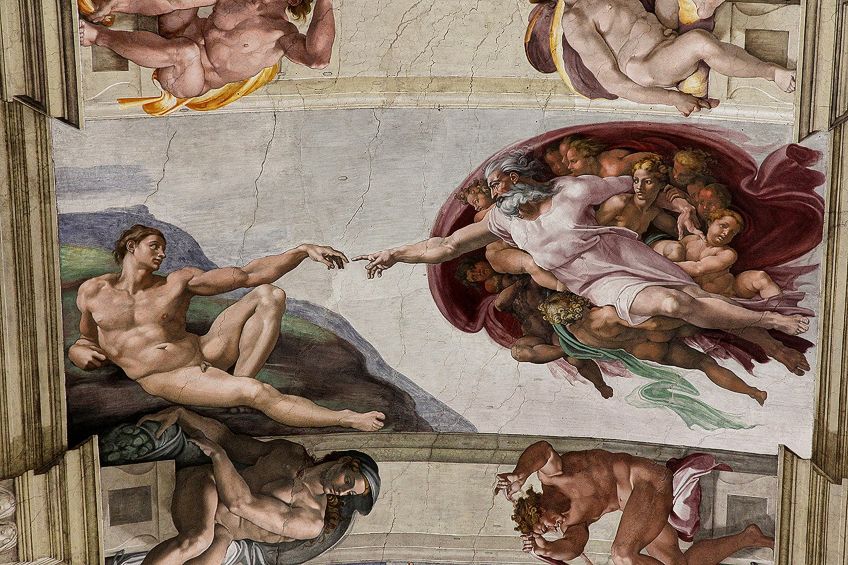 Creation of Adam fresco painted by Michelangelo (1475-1564), Sistine Chapel Ceiling (1508-1512) Rome, Vatican;Jörg Bittner Unna, CC Past 3.0, via Wikimedia Commons
Centering effectually the nine capacity from the Book of Genesis, the composition contains over 300 various figures and stretches over 500 square meters. It is segmented into three parts: the creation of the earth, the cosmos of humankind, and the autumn from the grace of God. God is portrayed as an old, grey-haired white man cloaked in a swirling robe. Adam is depicted without any vesture and is reclining on the ground.
God'due south right arm is outstretched with his index finger reaching to bear upon Adam's finger, thereby bestowing life upon him. Adam's left arm is stretched out, a mirror image of the pose of God, a symbolic reflection that human was made in the image of God. Much debate has arisen as to the identities of the twelve figures surrounding God.
It is at present widely accustomed that the female under God'due south right arm represents Eve and that the other figures represent the children of Eve, the human race.
The Tower of Babel (1563) by Pieter Bruegel the Elder
Pieter Bruegel the Elder created 3 different paintings with the Tower of Babel every bit its subject matter. The start was painted in Rome and was a miniature created on ivory. The other two are the only surviving works that aren't lost to fourth dimension. They are referred to every bit the "Dandy" Tower and the "Little" tower. Both of these were painted on wood panels using oil paint. 1 is now housed at the Kunsthistorisches Museum, Vienna, and the other at the Museum Boijmans Van Beuningen in Rotterdam.
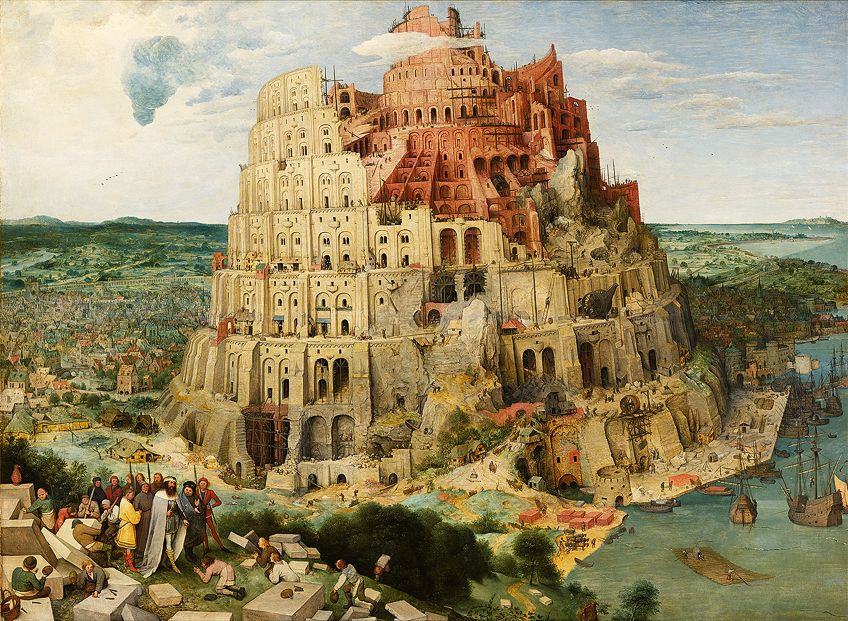 The "Great" Tower of Boom-boom (1563) past Pieter Bruegel the Elderberry, housed in the Kunsthistorisches Museum, Vienna;Pieter Brueghel the Elder, Public domain, via Wikimedia Commons
The painting housed in Rotterdam is approximately one-half the size of the other 1. Although they are based on the aforementioned subject and contain the same basic compositions, once 1 takes a closer look, information technology becomes evident that all the details vary greatly, from the landscape to the sky to the vastly different-looking tower.
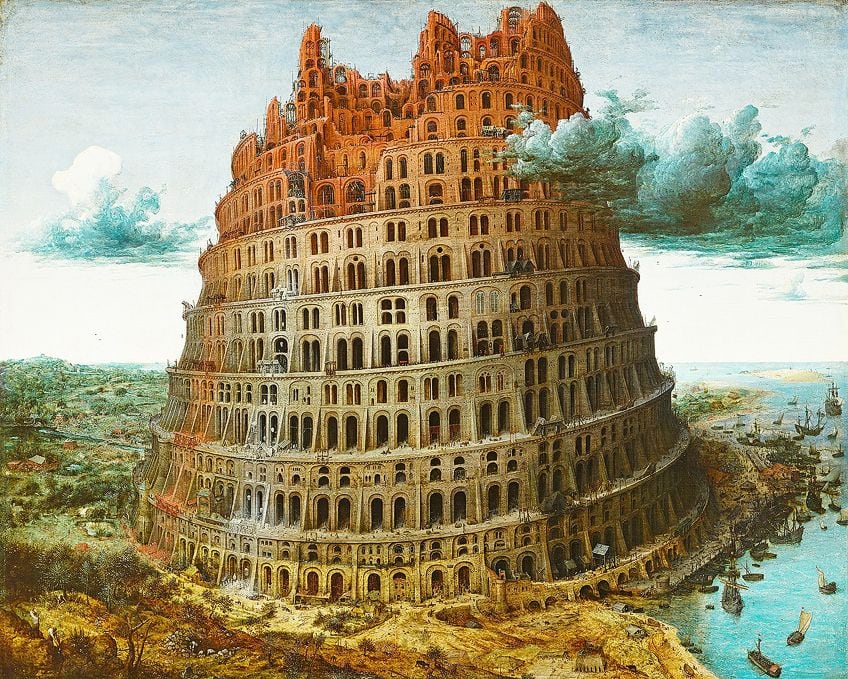 The "Little" Belfry of Babel (1568) by Pieter Bruegel the Elder, housed at the Museum Boijmans Van Beuningen in Rotterdam;Pieter Brueghel the Elderberry, Public domain, via Wikimedia Commons
This artwork portrays the building of the Tower of Babylon, a story from the Book of Genesis in which humanity unifies and creates a building that can reach the heavens in celebration of their achievements. This portrayal of the Tower of Babylon contains architecture that is notably Roman in character.
Apparently, this was done intentionally to reflect the Christian disdain for Roman rule. Artists in this flow were known to constantly describe parallels between Babylonian and Roman societies.
Notable Early Christian Artworks
From Medieval Christian fine art and through to the Renaissance period, Christain artwork has been created in many different mediums such equally paintings on canvas and murals on walls to Christian sculptures and architecture. Let u.s. take a look at some notable examples of early on Christian artworks.
Sarcophagus of Junius Bassus
This early Christian sarcophagus was made around 359 CE for the burial of Junius Bassus and is fabricated from marble. Information technology is considered the most famous of Christian sculptures and was originally placed under Old St. Peter's Basilica until its rediscovery in 1597. It is now housed under the Saint Peter's Basilica Museum in the Vatican. The detailed iconography embraces imagery from the former and new Testaments, and forth with the Dogmatic Sarcophagus, this Christian sculpture is one of the oldest surviving sarcophagi of this quality and condition.
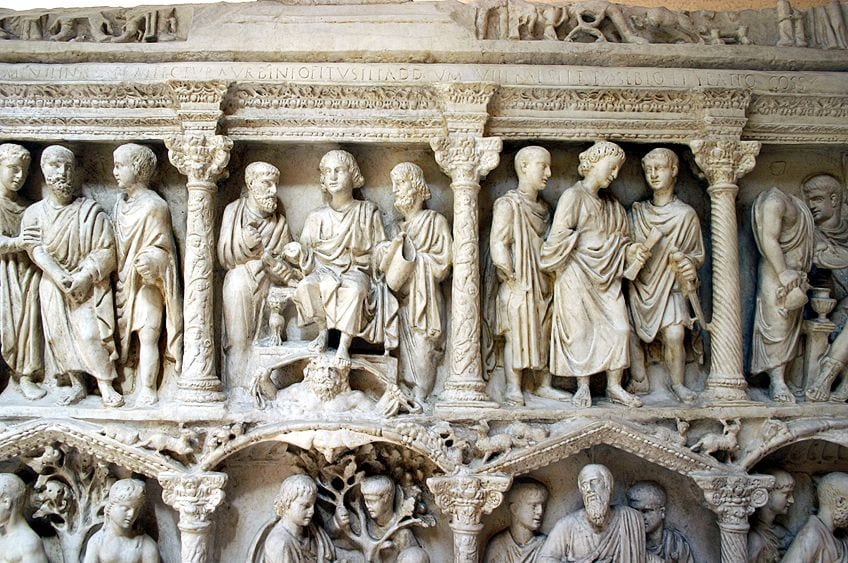 The bandage of the Sarcophagus of Junius Bassus (359 Advert). This is the oldest Christian sarcophagus embellished by reliefs of biblical and evangelical subjects, which survived until our fourth dimension. At the center is a scene of Traditio Legis;Giovanni Dall'Orto, Attribution, via Wikimedia Commons
The sarcophagus's possessor, Junius Bassus, was a senator in charge of the capital who died at the early age of 42. As Bassus was a high-ranking official, it was believed that it was not possible for someone to be both a senator and pious Christian. All the same, it is said that he converted to Christianity on his deathbed. The carvings are on three sides of the sarcophagus, allowing it to be displayed and positioned confronting a wall. The Anatolian fashion of arranging reliefs in columnar frameworks can be seen applied to this art piece.
Various scenes are depicted on this sarcophagus such equally the sacrifice of Isaac, the trial of Jesus, a depiction of Adam and Eve, and the judgment of Peter.
Basilica of Sant'Apollinare Nuovo
The Church building of Sant'Apollinare in Classe was originally built and designed past Arian Theodoric equally his palace chapel. Equally function of an attempt to suppress all references to his behavior, the Catholic Church reconsecrated the Basilica in 561 CE. This included the reworking of the mosaic art he had created. When the artifacts of Saint Apollinaris were transferred there in 856 CE, it became known as the Basilica of Saint Apollinaris.
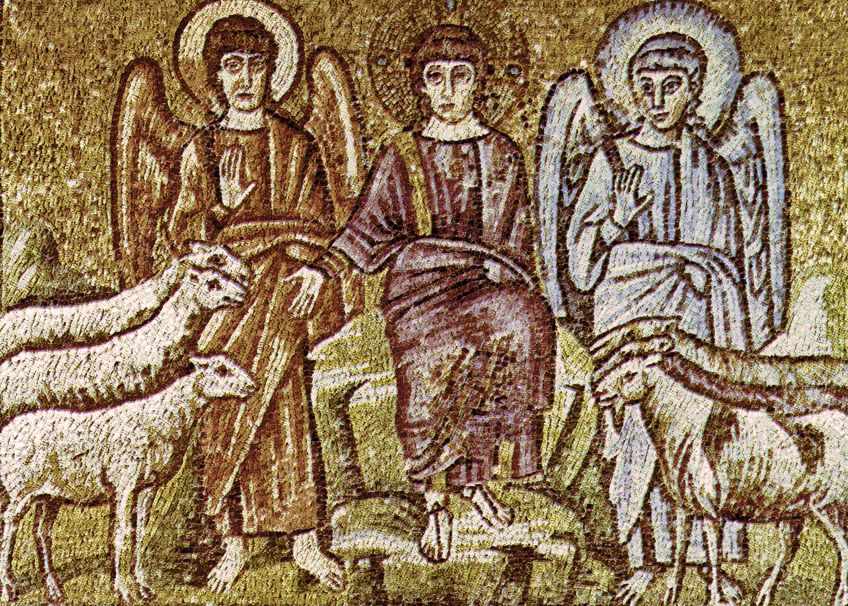 Christ divides the sheep from the kids, Sant'Apollinare Nuovo, Ravenna, 6th century;Basilica of Sant'Apollinare Nuovo, Public domain, via Wikimedia Commons
Of much interest to scholars are the mosaic works depicting the miracles and teachings of Christ, which have luckily survived regardless of the modernization and considerable renovation of the basilica over the years. Of particular interest to historians and scholars is the first appearance of the Devil in the history of art; to the left of Jesus appears a red affections situated backside three goats.
The Basilica of Sant'Apollinare Nuovo is a UNESCO World Heritage site and is regarded as one of the most crucially important sites of Medieval Christian fine art in Europe. This is chiefly due to the mixture of Eastern and Western Christianity motifs, every bit shown by the Eastern Orthodox (bearded) and Western Orthodox (non-bearded) versions of Christ.
Moses Striking the Stone (1624) – Joachim Anthonisz Wtewael
Moses striking the Stone was created in 1624 by Joachim Anthonisz Wtewael and typifies his lifelong association with and use of mannerism. Mannerists created artificial nevertheless elegant scenes using elongated figures, alternating calorie-free, also as night patterns and contorted poses. This artwork portrays the moment that God enabled Moses to lead the Israelites out of the land of Egypt, as told in the Book of Exodus. Surrounded by the children, women, and animals, Moses strikes the rock with the very aforementioned rod that he had previously used to office the Crimson Bounding main.
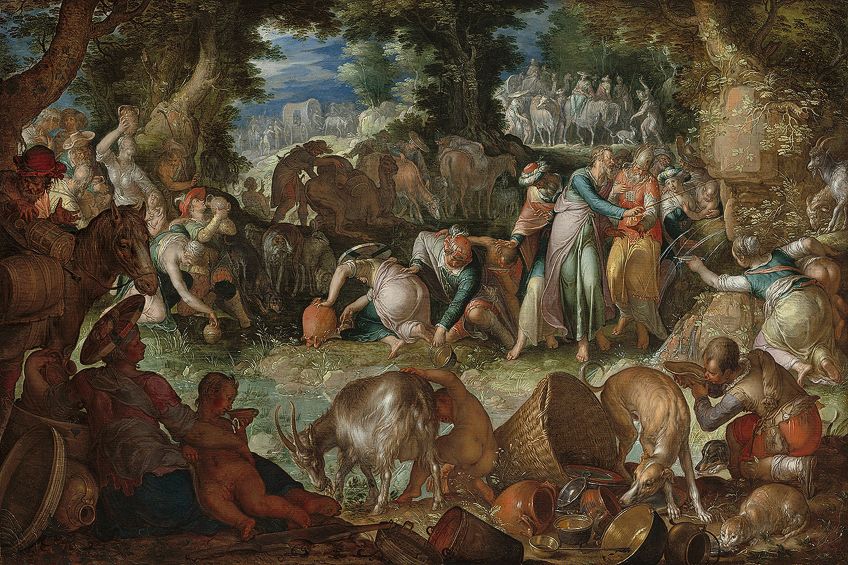 Moses Hit the Rock(1624) past Joachim Anthonisz Wtewael;National Gallery of Art, CC0, via Wikimedia Commons
This story had particular significant to the artist and other Dutch people as they were able to draw parallels between their fight for independence from the Spanish and the biblical story. Moses was seen equally a religious allegory of their ain leader, Prince William of Orange, who was the hero of the Dutch Revolt, and similar Moses, did not live to see his promised land.
Wtewael was an ardent supporter of Orangish, and it is thought that his decision to paint the scene was washed to help revitalize the public perception of the Prince to their version of Moses incarnate.
Adoration of the Magi (1481) by Leonardo da Vinci
Leonardo da Vinci was commissioned past the monks of San Donato in Florence to paint The Admiration of the Magi in 1481. He, however, departed for Milan the next year, leaving the painting incomplete. Since 1670, it has been housed at the Uffizi Gallery in Florence. In this unfinished Christian artwork, da Vinci has portrayed the Virgin Mary and Child in the foreground, and the Magi kneeling at her feet in devotion with the figures all forming a triangular shape on the sail.
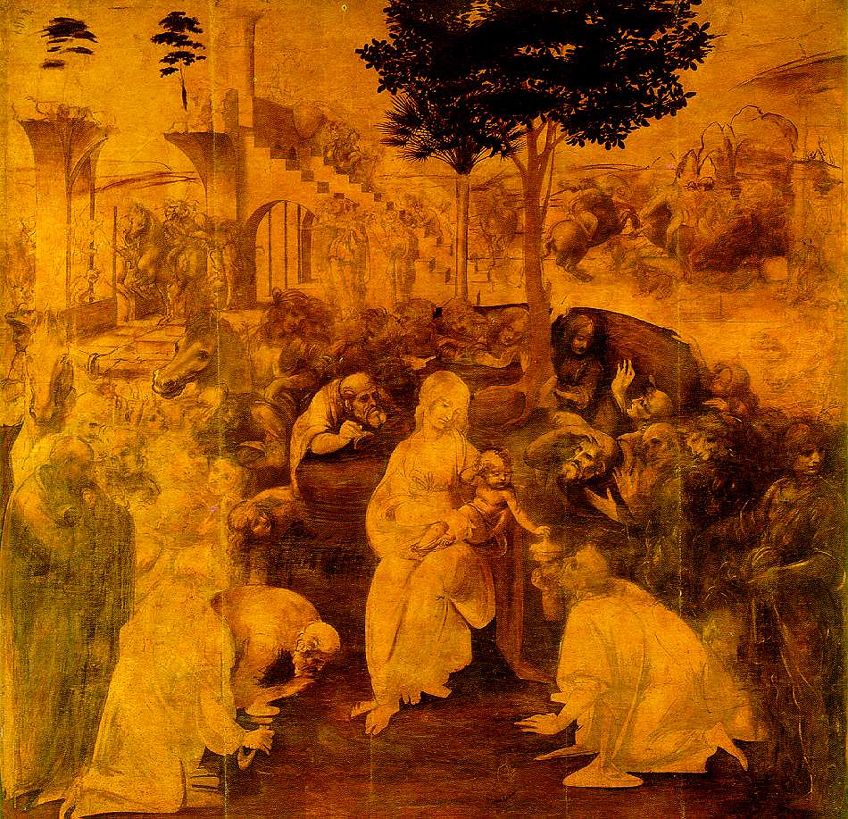 Admiration of the Magi (c. 1481-1482) by Leonardo da Vinci;Leonardo da Vinci, Public domain, via Wikimedia Eatables
In the background, a semicircle of people tin can be seen accompanying the virgin and kid, one of which seems to be a self-portrait of da Vinci himself. On the left of the background are the ruins of a pagan building. Workmen tin exist seen carrying out repair works to sections of information technology. On the right of the scene is a rocky landscape and men fighting on horseback. It has been suggested that the ruins on the left are possibly a reference to the basilica of Maxentius.
It was role of Medieval fable that the basilica would stand until the miracle of a virgin nascence.
The basilica was rumored to have suddenly collapsed on the dark of the birth of Christ, but in truth, information technology would be many years before it was even built. The palm tree has been said to be a symbolic representation of both ancient Rome as well as Mary herself. This is due to the phrase from the vocal of Solomon "you are equally stately as a palm tree". Its symbolism of Rome stems from the apply of the palm tree to stand for the triumph of good over evil, and the triumph over death.
Transfiguration (1516 – 1520) by Raphael
Commissioned by Primal Giulio de Medici and created for the Narbonne Cathedral in French republic, this altarpiece was the final painting by Raphael, the Italian Renaissance master. He worked on information technology from 1516 until his death in 1520. From the fourth dimension of its creation until early in the 20th century, information technology was regarded every bit the near famous oil painting in the known world.
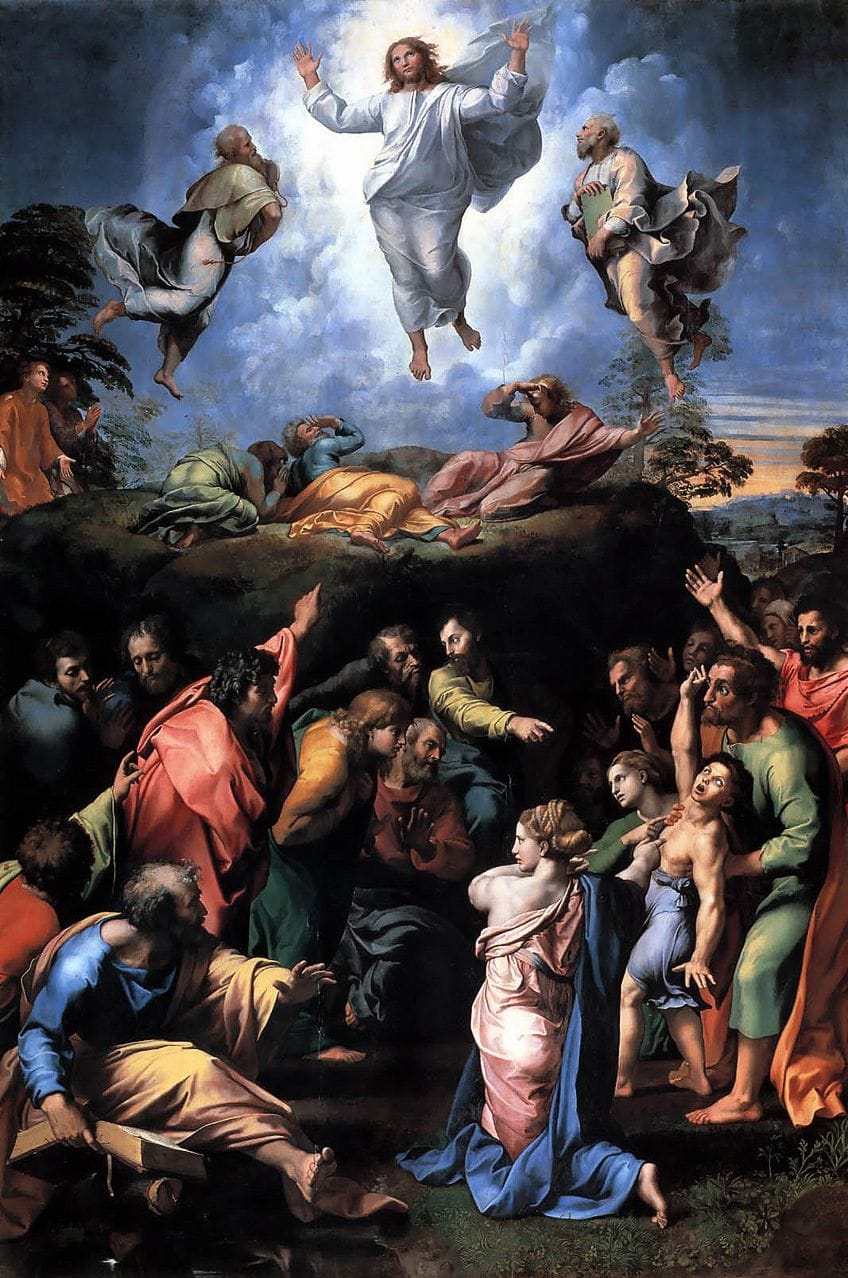 The Transfiguration (1520) by Raphael, unfinished at his death; Raphael, Public domain, via Wikimedia Commons
This artwork depicts ii distinct biblical stories from the Gospel of Matthew. On the top one-half of the canvas is a delineation of the transfiguration of Christ equally he radiates in celebrity, hovering above James, John, and Peter, who look on in wonder. On the lower one-half of the canvas, the apostles endeavour and fail to bewitch demons from a child and eagerly await the return of Jesus. The arrival of Christ has resulted in the kid being cured as he stands with his oral cavity agape and his arm raised towards the hovering Christ.
As his last piece of work of fine art, Raphael created this artwork every bit his final attestation to the miraculous ability of Christ to heal the sick. This last masterpiece is said to contain stylistic elements of both Baroque painting and the Mannerism move. At its near basic level, the painting represents the dichotomy of the Divine nature of Christ assorted with the struggles and flaws associated with mankind.
We have learned that Christian art was hidden in the early days due to the suppression of Christianity by the Roman Empire. It wasn't until the rule of Constantine that things inverse drastically, where Christianity became the religion ordained by the state and began to flourish. Afterwards that, Christian fine art could be constitute in temples, churches, and public areas. Since the early forbidden days of medieval Christian art through to the Renaissance, Christian art has experienced a colorful and epic journey of revival and survival. From the simplistic motifs on makeshift churches to the masterful frescos adorning the walls of chapels and cathedrals, Christian art has gone from underdog to overlord.
Take a expect at our Christian artwork webstory here!
Frequently Asked Questions
Why Is It And then Hard to Find Early Examples of Christian Art?
In the early on days of the religion, nearly of the people who followed information technology were too poor to beget art supplies. Many of them also believed that God should non be depicted visually, and refrained from creating artwork that portrayed holy deities. In one case Constantine changed the national landscape to one dominated by Christianity, churches started commissioning art and it became socially acceptable and financially viable for them to start creating Christian artwork. Before such a time every bit it became acceptable, artists had to carefully use symbolism to correspond Christ and other Christian motifs in gild to hibernate them from the Roman Empire. Afterward the political and economic situation in the region improved, artists were able to start creating personal works of art that were free from persecution from the ruling stare.
What Subject Matter Did Early Christian Artists Pigment?
As most works were commissioned by the churches, the majority of the subject field affair was decided on past the clergy, although some artists were able to enjoy some gratuitous reign over what they could pigment. The near common field of study matter involved scenes of the birth and death of Christ, besides as scenes of creation such every bit the story of Adam and Eve, or even apocalyptic scenes. These paintings were created to simultaneously inspire the masses to devotion as well as instill the fear of hell, thus encouraging submission.
Source: https://artincontext.org/christian-art/
0 Response to "The Compositions of Many Early Christian Reliefs Derive From Which Earlier Styles of Art?"
Post a Comment