How Did Marcel Duchamps Fountain Help Change the Definition of Art?
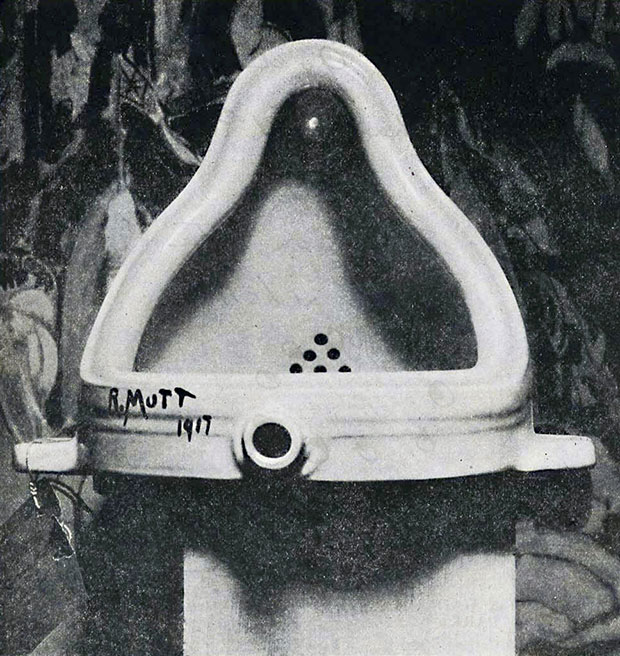
The fascinating tale of Marcel Duchamp's Fountain
Photographed by Alfred Stieglitz, urinated on by Brian Eno, sometimes cited as the work of a German baroness, Marcel Duchamp'southward Fountain was arguably the first ever piece of conceptual art and harbours a fascinating backstory
Photographed, then afterward thrown away, by Alfred Stieglitz, urinated on by Brian Eno and sometimes cited as the piece of work of a Bauhaus baroness rather than the man it is most commonly associated with, Marcel Duchamp's Fountain is arguably the showtime slice of conceptual fine art ever, certainly the almost famous gear up made in art history, and has inspired countless artists from Grayson Perry to Damien Hirst, Richard Hamilton to Richard Wentworth and inspired many others to 'collaborate' with it in the most obvious way in gallery and museum settings. . .
In the gently flowing curves of Fountain Duchamp biographer Calvin Tomkins claimed one could discern 'the veiled head of a archetype Renaissance Madonna or a seated Buddha or, mayhap more to the point, i of Brâncuși's polished erotic forms. Others have likened the work to an erect penis and testicles or even "a small-scale woman with her caput covered".
One thing is articulate: for such an important landmark in fine art history Fountain was incredibly short lived. Subsequently photographing the piece in his studio, Alfred Stieglitz disposed of the urinal, meaning that what yous will gaze upon in any gallery or museum now will be one of 17 replicas commissioned by Marcel Duchamp in the 1960s.
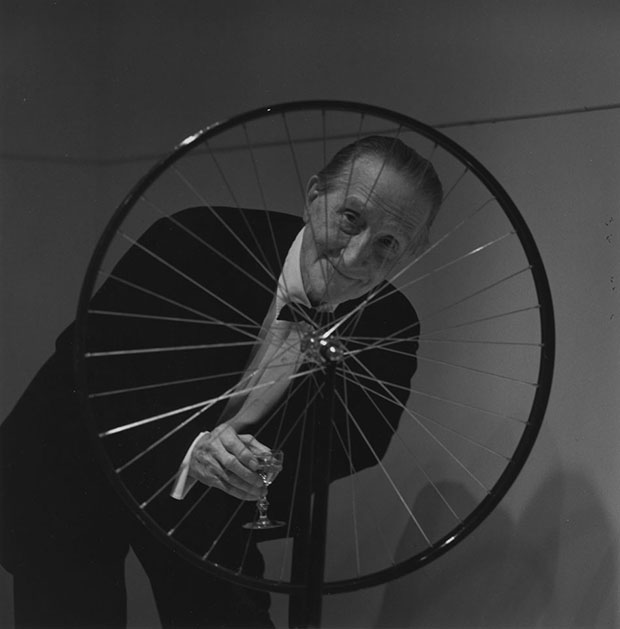
Marcel Duchamp and Bicycle Wheel (1913)
With Fountain Duchamp pretty much invented conceptual art and thus cut the accepted link between an artist'due south labour and the supposed 'merit' of the piece of work. It has been mooted that in putting the urinal frontward equally a work of art Duchamp, who came from a small town near Rouen, close to the battlefields of Globe State of war One, was discrediting the ability and continuing of the virtuoso artist and the critics who sabbatum in adoration and judgment in the same mode that the awful atrocities of the state of war had discredited the powers of authority.
With Fountain Duchamp, who had arrived in New York from Paris in 1915, revolutionised the 'creation' of fine art and effectively posed the questions: Who is an artist? And what is art?
Duchamp had begun deliberating on the idea of a 'readymade' a year or two earlier. The first, in 1913, was a bicycle wheel on a stool which he said he simply 'liked looking at'. Despite its equally lowly beginnings, Fountain was an altogether sexier offering – sexual attraction and sexual difference being 2 of Duchamp's obsessions.
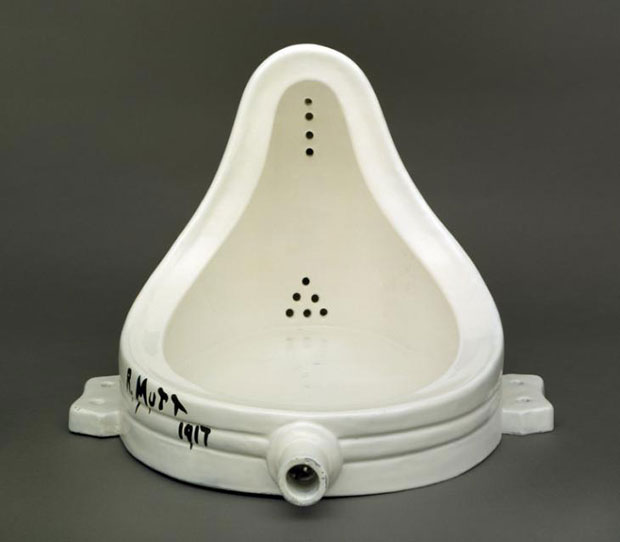
Fountain - Marcel Duchamp
Of all Duchamp's readymades, Fountain is the best known perhaps considering its symbolic pregnant takes the conceptual challenge posed by the readymade to its most visceral extreme. Duchamp, who saw America as the land of the huckster and Fountain as much practical joke equally it was a serious endeavour to reconfigure the art world, signed the porcelain urinal 'R.Mutt (a possible reference to the gambler Mutt in Bud Fisher's Mutt and Jeff cartoon) and it was submitted for the exhibition of the Society of Contained Artists in 1917, the first annual exhibition past the Club - of which Duchamp was a board fellow member - to be staged at The Grand Cardinal Palace in New York.
However, Duchamp was not known equally its creator (though most suspected him to be). Instead, as Alfred Stieglitz wrote "A immature woman sent a large porcelain urinal on a pedestal to the Independent(southward)."
Duchamp never identified his 'collaborator' – if indeed in that location was one - merely the young woman of Stieglitz's description has variously been identified equally either Baroness Elsa von Freytag-Loringhoven, an eccentric German poet and artist who loved (but who was jealous of) Duchamp; or Louise Norton, who contributed an essay to (the art and Dada journal) The Blind Man discussing Fountain.
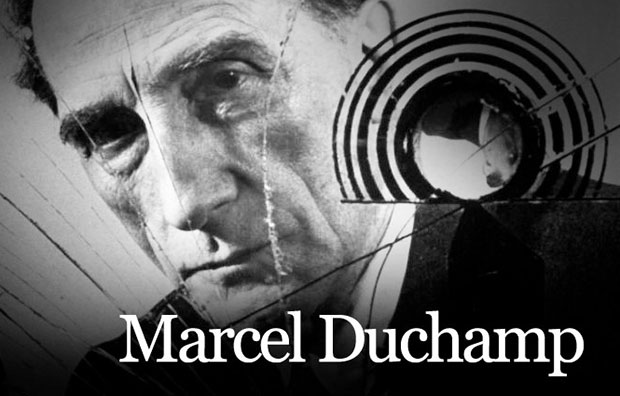
Marcel Duchamp
Certainly, Freytag-Loringhoven had created broadly similar, scatological works simply nothing that held the thinking expressed in Duchamp's piece. Norton meanwhile, was living at the time in an flat owned by her parents at 110 W 88th Street in New York Urban center, and this accost is partially discernible (along with "Richard Mutt") on the paper entry ticket attached to the object in Stieglitz'south photograph.
Duchamp later said that he had not made his own identity known considering of his position on the guild's lath. As 'R Mutt' was an unknown Duchamp thught he could test the board's openness to art that didn't conform to conventional standards without compromising his human relationship with the other board members.
But Fountain was rejected by the commission, fifty-fifty though the rules stated that all works would be accepted from artists who paid the fee. After some consternation and a brief discussion information technology was decided that the vi dollar submission should be returned to 'Mr. Mutt' with a letter stating that it had no place in an art exhibition. Duchamp immediately resigned from the society stating that "The only works of fine art America has given (the earth) are her "plumbing and her bridges".
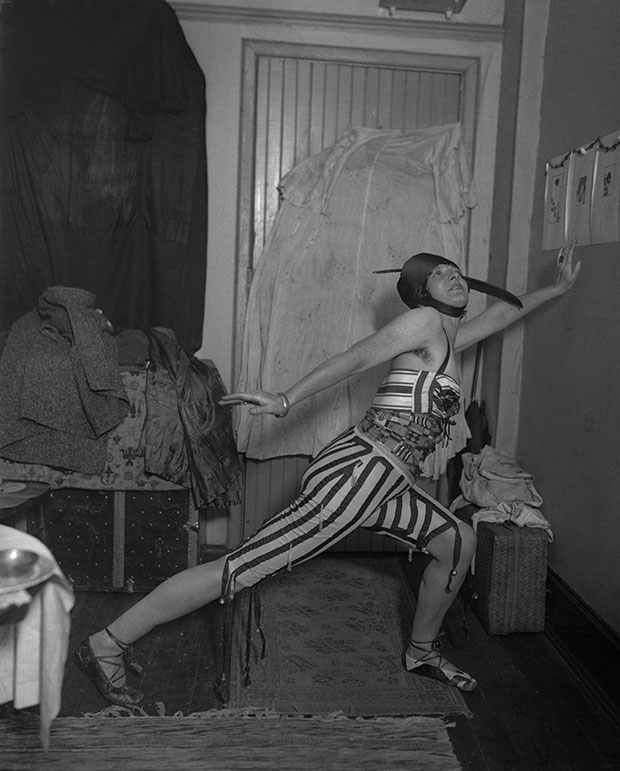
Baroness Elsa von Freytag-Loringhoven
Philosopher Stephen Hicks believed that Duchamp, who was quite familiar with the history of European art, was making a profoundly provocative statement with Fountain:
"The creative person is a not great creator—Duchamp went shopping at a plumbing store. The artwork is non a special object - it was mass-produced in a factory. The experience of art is not heady and ennobling - at best information technology is puzzling and by and large leaves i with a sense of distaste. But over and in a higher place that, Duchamp did not select just any set-made object to brandish. In selecting the urinal, his bulletin was clear: Art is something you piss on."
Learn more nigh Marcel Duchamp, conceptual art, readymades in The Art Book, Art in Time, Fine art & Today and our two books on Dada.
Source: https://www.phaidon.com/agenda/art/articles/2016/may/26/the-fascinating-tale-of-marcel-duchamps-fountain/
0 Response to "How Did Marcel Duchamps Fountain Help Change the Definition of Art?"
Post a Comment