Olympus Mzuiko Ed 14-150mm F/4-56 Ii Lens Review
Introduction
Specifications and Features
Like other early models, the original M.Zuiko Digital ED 14-150mm with its false-scalloped zoom ring from 1950s was deliberately retro-looking. While information technology suited the before PEN models, the artful started to wait a little out place on SLR-fashion OM-D bodies. This updated model introduced in Feb of 2015 is more in line with the maker'south distinctive-looking pro-oriented models featuring a finely-machined darkened chrome stop of the focus and zoom rings and a weather condition-proof exterior (Olympus claims that this model is hermetically sealed).
Internally, the construction remains the same, and it'southward a relatively circuitous formula that reveals Olympus' blueprint savvy with 15 elements in eleven groups, complete with three aspherical elements: one double-sided aspherical (DSA) element, one aspherical ED (EDA) glass, and one conventional unmarried-sided asphere.
In addition, information technology has one large-diameter ED element and iii farther dissonant dispersion elements, which though similar to ED, aren't quite as effective. The update likewise includes the thin-film ZERO actress-low reflection blanket kickoff seen on the high-grade 75mm f1.viii model. The original zoom was i of the first to prefer the maker's high-speed screw-driven MSC AF mechanism for smooth and nigh-silent AF, and that'southward unchanged in the new model.
Like the original, the lens focuses to 1.64' (50cm) at all focal lengths. Information technology adopts 58mm filters and measures two.5 10 three.3" (63.v 10 83.8mm) and weighs just ten oz (285g), 5g more than its predecessor. It is available at present for around $600 (USD).
Specifications
- 15 elements arranged in 11 groups
- F4.5-5.half dozen constant aperture
- Direct-drive type AF motor
- Aspheric surfaces
- ED blazon glass
- 1.64' (50cm) minimum focus
Medium score and low tiptop sharpness
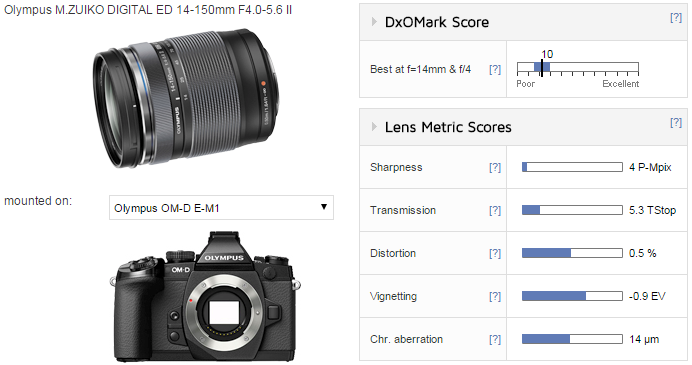
With a DxO Mark lens score of 10 points and a pinnacle sharpness of 4P-Mpix, meaning the 16-Mpix sensor and lens combination delivers around 4-Mpix of detail at its optimal setting, the lens is a skillful performer for a super-zoom.
Like most zooms, specially models with a high zoom ratio, consequent performance is an effect and performance varies throughout the zoom range. It's a noticeably better performer at the shorter focal lengths, where sharpness extends to the borders but retreats to the centers on zooming in (increasing focal length). In terms of ranking, therefore, information technology doesn't compare well with shorter-range zoom models, simply it is competitive against like offerings.
Super-zooms like this trade outright image quality for convenience
Olympus 1000.ZUIKO DIGITAL ED 14-150mm F4.0-v.half dozen II versus Olympus M.ZUIKO DIGITAL ED xl-150mm f4.0-v.six versus Olympus M.
We've not had the opportunity to test the earlier model, but comparing it with the $236 ED forty-150mm and the newer $499 12-50mm, we can run across that both those models are amend performers. However, this is not as straightforward every bit the figures suggest.
The 40-150mm is an excellent performer in the center of the range (around 70mm), simply non so much at the extremes of the range. However, it is marginally sharper across the field from 70mm upwardly and has better uniformity, slightly lower distortion and vignetting, and far superior control of chromatic aberration. At 40mm, however, it performs similarly.
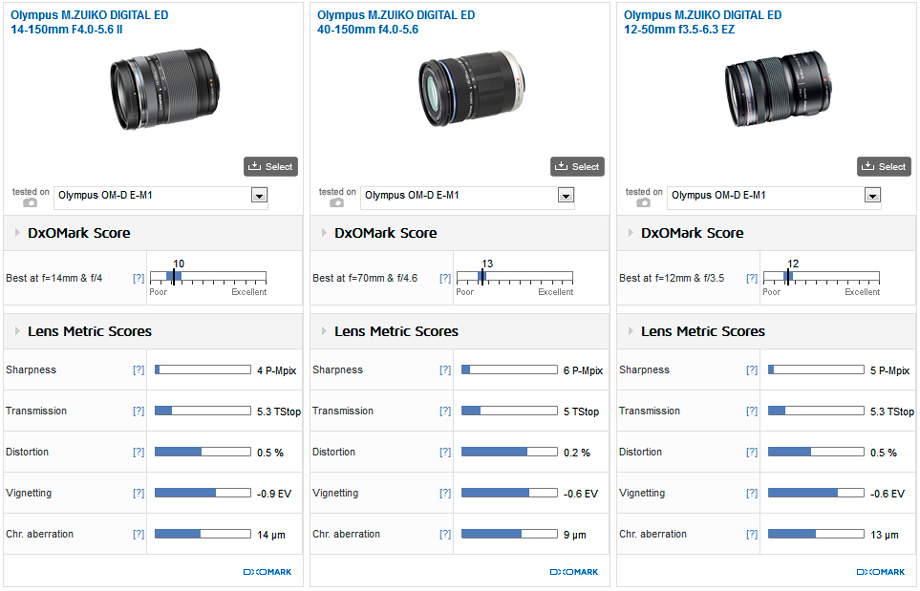
While the 12-50mm isn't quite as sharp or as consistent across the field at 12mm as the 14-150mm is at 14mm, that position changes between 20-28mm — though it swings back in favor of the 14-150mm from 35mm onwards, where the super-zoom is sharper centrally at least. Baloney and vignetting are very like, but the 14-150mm has high levels of chromatic abnormality from 45mm upwards (and excessively so at 70mm).
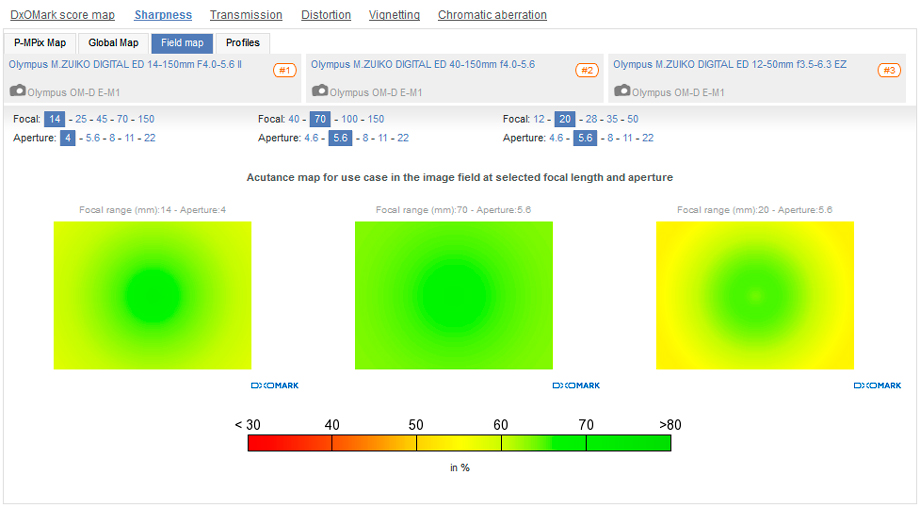
Optimal sharpness varies considerably between the 3 models, but the fourteen-150mm is at its sharpest wide-open up at 14mm
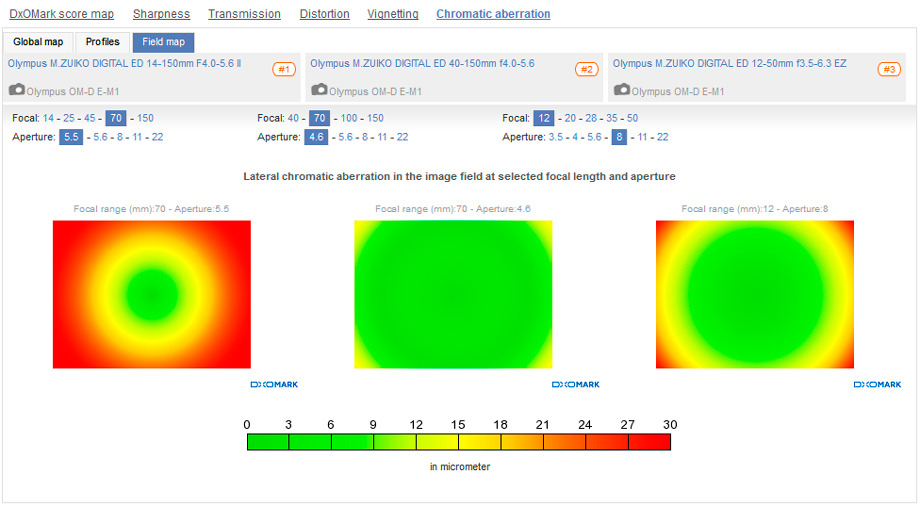
Comparing worst-example chromatic aberration, the 14-150mm has high levels in the outer field at 70mm, simply information technology's reasonably well-controlled at the end of the zoom range
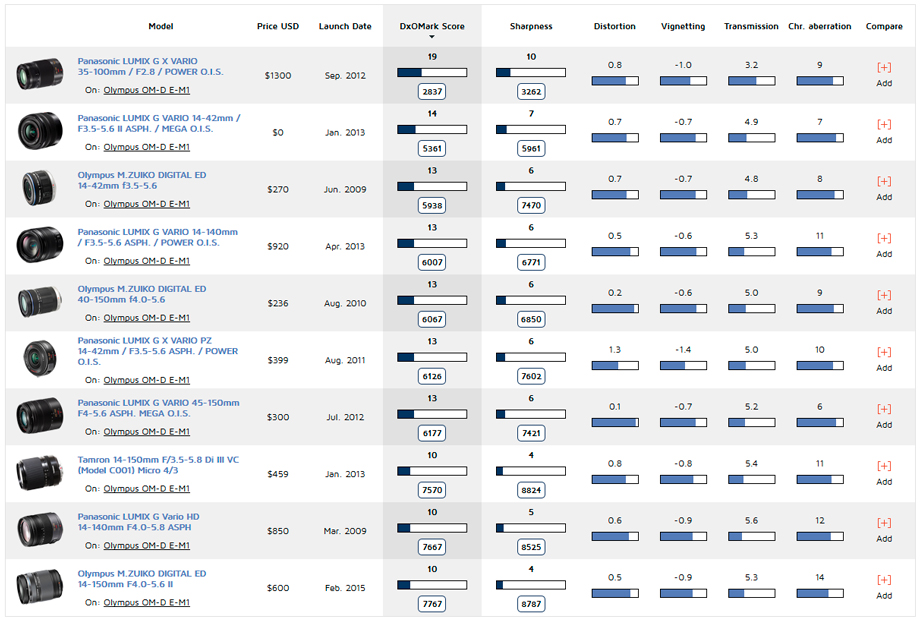
Olympus M.ZUIKO DIGITAL ED fourteen-150mm F4.0-five.half-dozen II versus Panasonic LUMIX 1000 VARIO 14-140mm / F3.v-five.half dozen ASPH. / Ability O.I.S. versus Tamron xiv-150mm F/3.5-5.8 Di Iii VC (Model C001) Micro four/3: Non quite a friction match for the redesigned Panasonic
With Panasonic updating its popular if somewhat pricey $920 14-140mm with a new design, and third-party maker Tamron offer a new $459 xiv-150mm to rival both slightly faster at the wider terminate, Olympus' update looks rather timely.
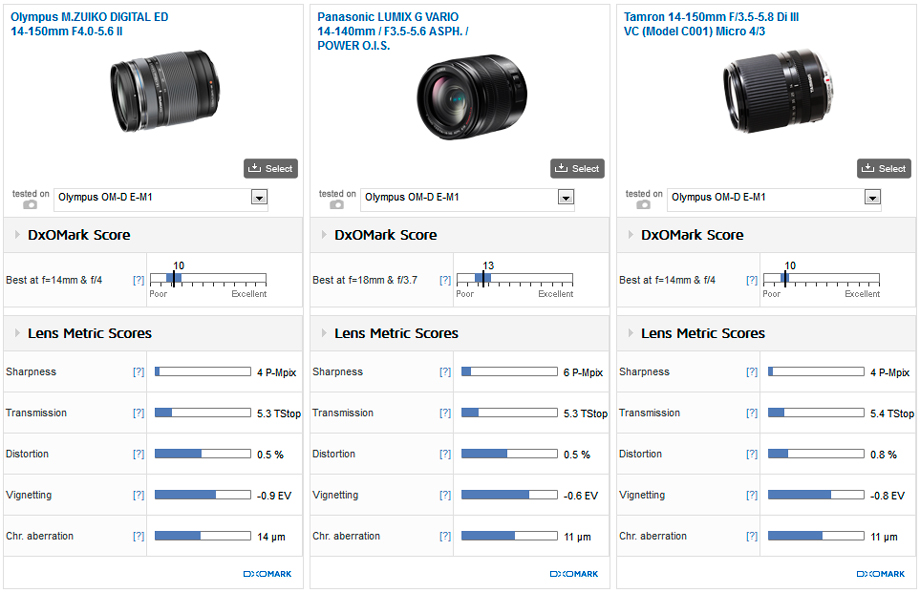
However, it still really but matches the Tamron, with the Panasonic a noticeably ameliorate performer at the wider stop in terms of sharpness and uniformity. The Panasonic also has the highest meridian sharpness levels of the three, albeit at the wide end. At the longer cease, particularly at 150mm, all iii are quite close centrally, though the Olympus is noticeably softer in the periphery. In terms of distortion, the Panasonic has more than noticeable butt distortion at 14mm, but the lowest from 28mm up; it also has the everyman vignetting and very good control of chromatic aberration.
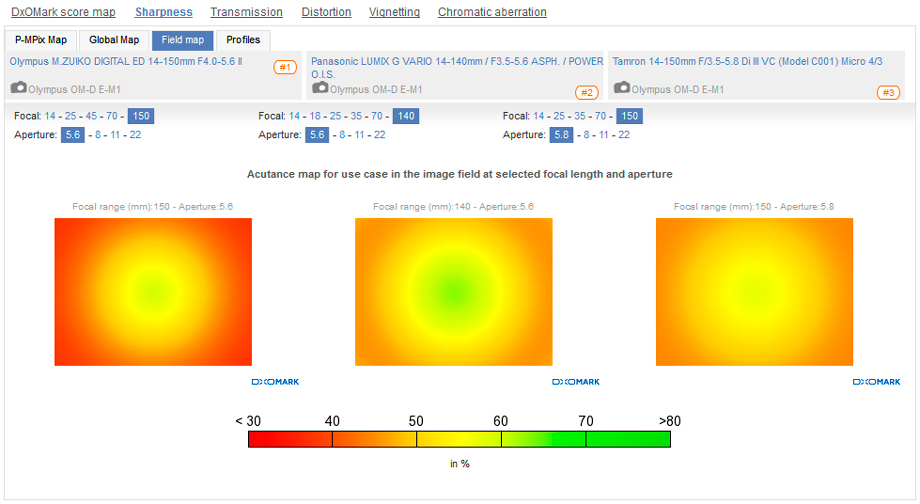
All three models are a little disappointing at 150mm in terms of sharpness, with the Panasonic beingness the sharpest centrally
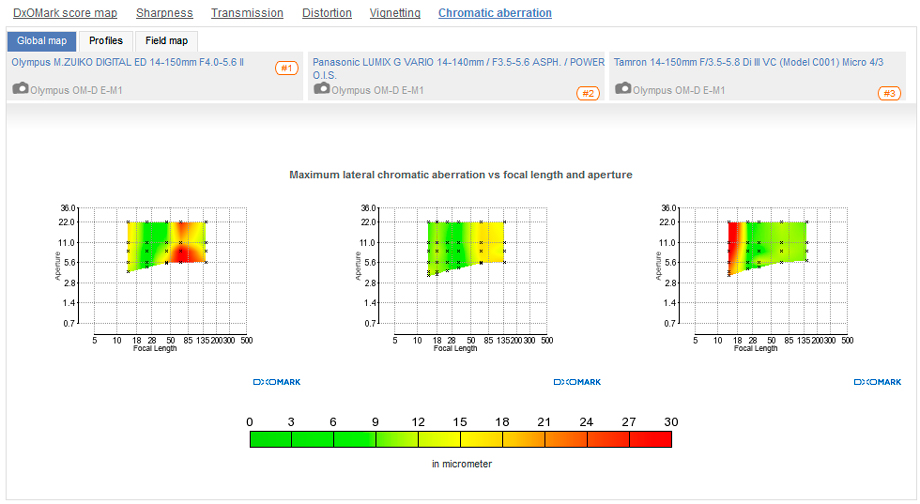
The Tamron has some CA around the 14mm marking in the corners, merely it's not as severe as the Olympus. Past contrast, the Panasonic is very well controlled
Conclusion
Overall, the Olympus with its high ratio zoom is an attractive lens for still photographers and videographers and the updates are welcome; withal, at around $600, it's looking a little expensive when compared with the recently-introduced Tamron equivalent at merely $459. Nevertheless, although the Tamron performs similarly, it's not quite as impressive at 14mm as the Olympus. The Panasonic 14-140mm concedes a fiddling reach at the long end, but it'due south a ameliorate performer optically at practically every focal length. Nevertheless, at $920, it'due south quite a commitment. With the current deals available bringing the toll to within $40 of the Tamron, at least for the moment, the Olympus with its impressive weather condition-proofing looks a lot more than tempting every bit a one-lens solution for the frequent traveller or budding videographer.
Source: https://www.dxomark.com/olympus-m-zuiko-digital-ed-14-150mm-f4-0-5-6-ii-lens-review-promising-all-round-option/
0 Response to "Olympus Mzuiko Ed 14-150mm F/4-56 Ii Lens Review"
Post a Comment